
Community Archive Stories
Queer and Crip Experiences in a Collapsing Universe
An event by liminal as part of the GREECE 3.0 programme, curated and facilitated by Tomas Diafas.
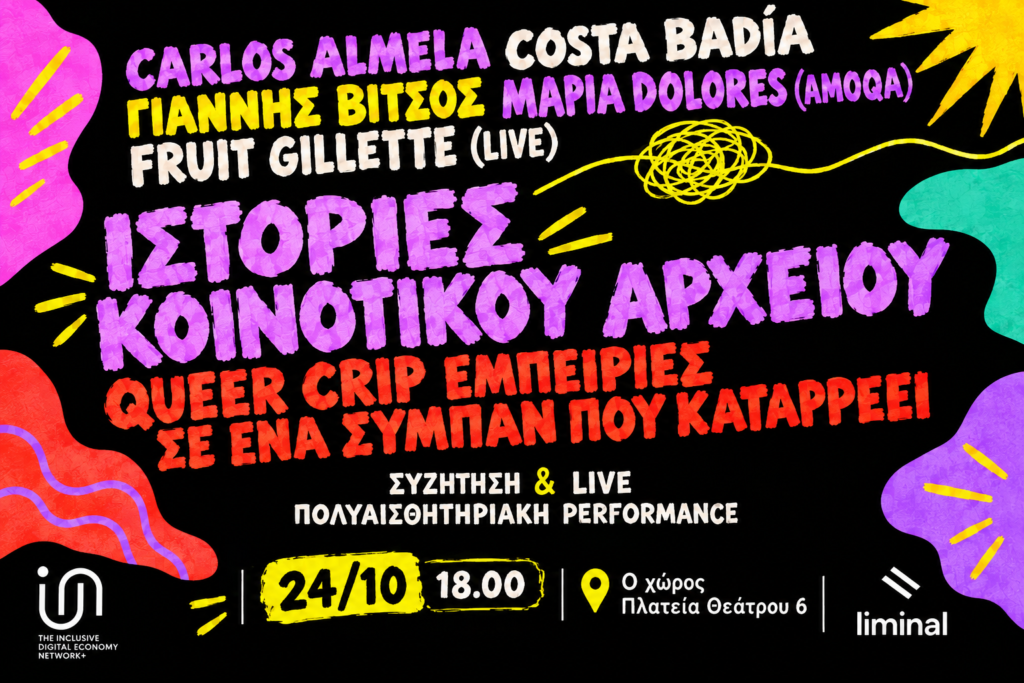
How do we preserve a community’s history when no institution takes responsibility for documenting it?
On Saturday, October 24 2026, at 18:00, we invite you to join us at Choros of liminal for an encounter that brings together the collective memory and self-organisation of queer1 and crip2 communities with artistic expression.
The event opens with a discussion on shared experiences and practices of self-organisation, followed by an experimental performance by Fruit Gillette, developed in collaboration with the “GREECE 3.0” team, in which accessibility becomes an integral part of the artistic process.
The event is an invitation to open up a space for dialogue, connection and exchange between people from different communities, with diverse identities and lived experiences.
Part One: Discussion
“Self-Organisation as a Means of Survival in a Collapsing Universe”
What does it mean to survive when the institutions meant to support you are absent, fail you or exclude you from the outset? For many queer and crip communities, self-organisation has never been a choice or an ideological preference. It has been a necessity.
When the state fails to provide access, care or recognition, communities build their own networks of mutual support, create their own spaces, develop their own codes and cultivate their own forms of knowledge. Each of these practices also becomes a form of archive: knowledge passed from mouth to mouth and body to body, often without ever being officially documented.
The discussion explores what we can learn from communities that have learned to survive “in parallel”. Which practices have stood the test of time, and why? When has self-organisation become a form of tangible care, and when has it led to exhaustion, particularly when those who fill the gaps left by the state often lack both resources and time to rest? And how can a community preserve its cohesion and collective memory when the world around it is falling apart?
The discussion will feature:
Carlos Almela
A cultural manager and curator actively involved in queer, crip and anarchist alliances. He will share examples and practices from Spain, exploring the concept of vulnerability in times of fascism.
Costa Badia
The artist will discuss the disability rights movement in Spain, Crip Theory and her work at Tullida Gallery, where she is currently working. Drawing on her body as an archive of lived experiences and a source of inspiration, she will explore how her personal experience informs her artistic practice.
Yannis Vitsos
A content creator focusing on LGBTQI+ and disability issues, he will approach the same questions from the perspective of the disability rights movement in Greece: How has access been fought for? What struggles have emerged from grassroots movements, and what remains of them today?
Maria F. Dolores
A visual artist, performer and member of AMOQA (Athens Museum of Queer Arts), a self-managed space dedicated to promoting transfeminist culture through art, theory and activism. This year, AMOQA celebrates its tenth anniversary with the question: What if museums were gardens?
Christos Papamichael
Founder of liminal. He will discuss the importance of creative accessibility, highlighting both the opportunities and the challenges involved in creating art without barriers.
The dialogue between queer and crip histories brings shared threads into focus: mutual support as a principle of collective organisation, accessibility as an act of care, and vulnerability as a source of collective strength.
Part Two: Drag Performance
Fruit Gillette and the “GREECE 3.0” team, comprising disabled and non-disabled participants, will present the outcome of a collaborative workshop exploring ways to make the artist’s performance of “GYNAIKA TSIMENTO” (“WOMAN CEMENT”) accessible.
Fruit Gillette inhabits a tactile, multisensory installation designed by and for people with sensory and mobility disabilities, inviting the audience to engage with it through all their senses. Through her performance, the performance becomes a way of remembering and caring for one another.
Project team
Programme Coordination and Artistic Curation: Tomas Diafas
Programme Coordination: Marilena Koukouli
Production Coordination: Christos Papamichael
Community Coordination: Andreas Plemmenos
Speakers
Carlos Almela – Cultural manager and curator
Costa Badía – Artist
Yannis Vitsos – Content creator focusing on LGBTQI+ and disability issues
Maria F. Dolores – Visual artist, performer and AMOQA member
Christos Papamichael – Founder of liminal Fruit Gillette – Artist
Discussion facilitated by: Tomas Diafas
Useful information
Date: Saturday, October 24 2026
Discussion starts: 18:00
Performance starts: 20:00
Location: Choros, Platia Theatrou 6, Athens (Map)
Free admission
❗ Due to limited venue capacity, admission will be on a first-come, first-served basis.
Accessibility
- The venue is wheelchair accessible and has an accessible toilet for wheelchair users.
- Assistance with getting around the venue can be arranged for anyone who needs it. Please do not hesitate to let us know.
- Greek Sign Language interpretation will be provided.
Please let us know about any additional accessibility requirements so that we can take them into consideration.
This event is organised by liminal as part of the GREECE 3.0 programme, with financial support from INCLUDE+.