
Greece 3.0 | Part 2
Co-creating a More Inclusive Future for the Performing Arts in Greece
Greece 3.0 returns, continuing its exploration of the relationship between art, accessibility, digital equality and institutional change in the cultural sector.
The topic
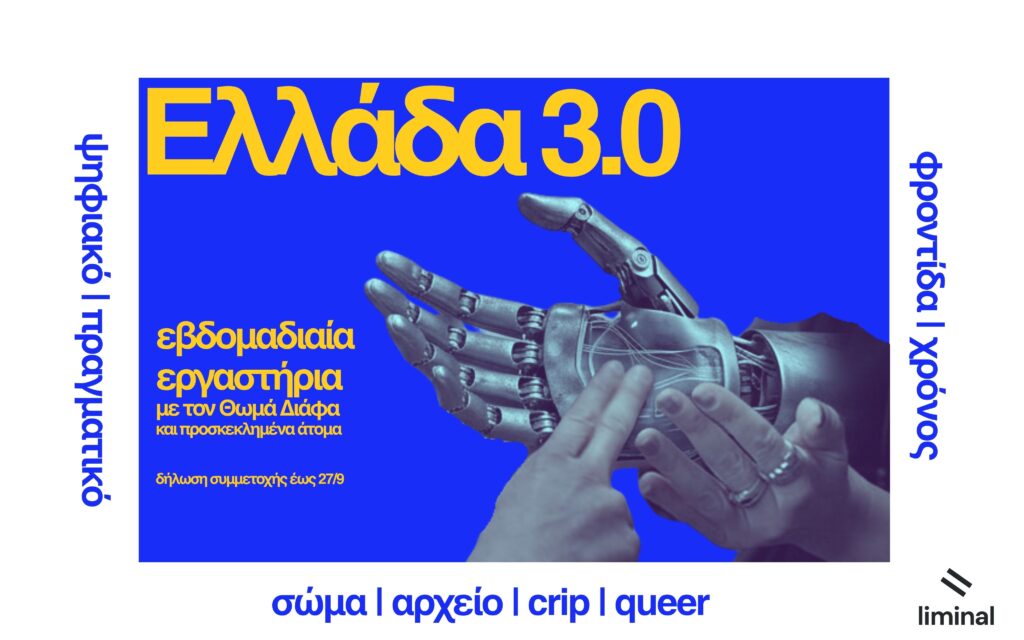
In the second part of the programme, the workshop, led by interdisciplinary artist Thomas Diafas, focuses on the Queer1 Crip2 body and care practices in Performance Art. It explores how the body, memory, time and lived experience can be transformed into artistic practice and archival knowledge.
Participants will be introduced to contemporary approaches to the Queer and Crip body, care and inclusion. At the same time, they will experiment with different forms of documentation and archiving: paper, camera, digital archives, memory and the body itself as a carrier of knowledge.
The aim is not simply to talk about accessibility, but to collectively create an environment in which accessibility is part of the artistic process itself.
The seminar will also welcome guest contributors Christos Papamichael, founder of liminal; Nikos Vogiatzis, archivist, artist, educator and media designer; and Fruit Gillette, visual artist, performance artist and musician. Each contributor will bring their own experience, knowledge and perspective to the discussion, enriching the dialogue around accessibility, community and culture.
What will we do?
In the first part of Greece 3.0, we focused on the archive of Artogether (formerly VSA Hellas) and explored how communities themselves can archive, narrate and preserve their histories, claiming an active role in shaping cultural memory.
In the second part, we continue from where we left off: we expand the archive and move from documenting history towards the lived experience of the body. We focus on Queer and Crip time, care practices and the performing arts, exploring ways in which personal and collective experience can become art, knowledge and archive.
🔎 Through workshops, discussions, exercises and artistic experimentation, participants will:
- co-create an accessible performance environment
- develop new artistic works
- digitally document practices, tools and experiences that can be used by artists, groups, organisations and cultural institutions
The knowledge generated through the programme will not remain within the workshop. It will feed into a series of creative feedback sessions with organisations, experts and institutional stakeholders. Together, we will examine the barriers that limit access to culture and explore possibilities for meaningful change.
🔵 At the heart of the programme is the triad: Lived experience of the community – Expertise – Institutions
How can these different forms of knowledge meet on equal terms?
How can lived experience have a meaningful place within institutional processes?
How can we move from talking about inclusion to co-creating real change within the cultural sector?
Dialogue and exchange
As part of the programme, there will also be public events featuring invited artists, researchers and cultural professionals who work with communities and organisations in Greece and abroad.
The process will culminate in the creation of a practical accessibility guide for the cultural organisations of tomorrow. The guide will bring together knowledge, practices and recommendations emerging from the research, artistic practice and dialogue with communities.
Greece 3.0 is an open invitation to imagine, experiment and build together the future of the performing arts in Greece: a future that is more open, accessible and inclusive for everyone.
Greece 3.0 approaches accessibility not as an addition to culture, but as a fundamental condition for how we create, present, archive and share art.
Who is it for
The programme is open to people with and without disabilities, with different levels of professional experience and an interest in the performing arts, archives and/or accessibility.
Useful information
When:
Tuesday, 29 September | 19:30–21:00 | Online
Introductory meeting and presentation of the programme and its work.
Saturday, 10 and Sunday, 11 October | 11:00–14:00 | In person
Two-day meeting at Choros of liminal.
Every Tuesday, from 13 October to 8 December | 17:00–20:00 | In person
Workshops at Choros of liminal.
Saturday, 24 and Sunday, 25 October | Two-day event
Public talks and discussions with invited speakers from Greece and abroad.
Friday, 11 December | Final presentation
Presentation of the work created throughout the seminar.
❗ The dates above are indicative. The final schedule may be adjusted depending on the availability of the group and invited speakers.
Where:
Meetings will take place at Choros of liminal, Platia Theatrou 6, Athens (Map).
Accessibility
- The venue is accessible and has an accessible toilet for wheelchair users.
- Support with transportation will be available for anyone who needs it. Please do not hesitate to let us know.
- Greek Sign Language interpretation will be provided during the meetings.
- Please let us know about any additional accessibility requirements so that we can take them into consideration.
How to apply
Those interested in participating are invited to complete the Participation Form by 27 September 2026.
Project team
Programme Coordination & Artistic Direction: Thomas Diafas
Programme Coordination: Marilena Koukouli
Production Coordination: Christos Papamichael
Community Coordination: Andreas Plemmenos
Contributors: Thomas Diafas, Christos Papamichael, Nikos Vogiatzis, Fruit Gillette
The programme is implemented by liminal with the financial support of INCLUDE+, an international network exploring how social and digital environments can be designed, developed and sustained in ways that support equal participation and the well-being of all.
- Queer: a term used to describe people whose sexual and/or gender identity does not conform to dominant norms. ↩︎
- Crip: a term used by the disability community to challenge stereotypes surrounding disability and highlight difference, autonomy, and self-advocacy. ↩︎
Queer GSL:
Crip GSL: