
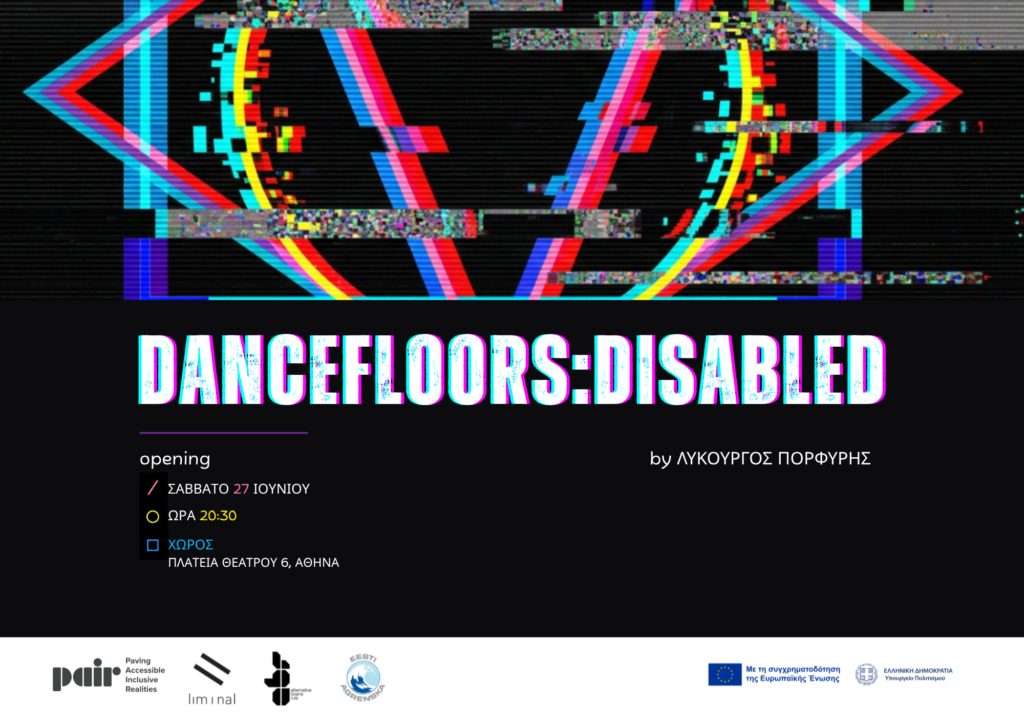
DANCEFLOORS:DISABLED
A multisensory installation by Lykourgos Porfyris
On Saturday, June 27, 2026, at 20:30, at Choros of liminal, we invite you to the opening of DANCEFLOORS:DISABLED, a multisensory installation by Lykourgos Porfyris that reimagines the dancefloor through the lived experience of disability. Combining sound, light, and video, the work approaches club culture as a space of accessibility, collectivity, and sensory experience.
👉 The installation will be open to the public on Sunday, June 28, 19:00–22:00 and from Thursday, July 2 to Sunday, July 5, 19:00–22:00.
What is DANCEFLOORS:DISABLED?
DANCEFLOORS:DISABLED is a multisensory installation that explores the dancefloor through the experiences of disabled people active in dance, music, and club culture.
At the core of the work are interviews structured around three questions:
- What does dance mean to you?
- How do you experience contemporary dancefloors?
- How do you imagine their future forms?
These narratives are transformed into three original sound compositions, drawing from techno and electronic music cultures. The voice becomes rhythm, testimony turns into sonic material, and lived experience shapes the musical structure, moving between driving beats and atmospheric soundscapes. The sound does not illustrate the stories, but emerges from within them.
Visitors are invited to enter the installation as they would a club space: to move, pause, listen, and experience the work at their own pace. The environment evolves gradually, creating a layered and immersive atmosphere.
Creative Accessibility
Accessibility is intrinsic to the work, informing both its aesthetic and its structure from the moment of conception rather than being added retrospectively.
The installation unfolds across multiple sensory layers that operate concurrently, in continuous dialogue with one another.
Sound is felt through the body as vibration. Large-scale, moving captions render speech as a dynamic visual field, while sign language interpretation is seamlessly woven into the visual composition. A third layer introduces abstract symbols that translate sound and frequency into form, generating a distinct visual language.
Each element operates both as a mode of access and as an artistic gesture, fully embedded in the aesthetic and spatial experience of the work.
You are not allowed to dance.
Why don’t you dance?
Why do you dance?
Why do you dance like that?
The work is shaped through collaboration with a Collaborative Working Group, in which the perspectives and experiences of disabled people and accessibility specialists play an active role and meaningfully inform the artistic process. From the design of the interviews to the development of the installation’s sensory elements, their contribution influences every stage of the work’s creation.
❗ The installation includes intense auditory and visual stimuli, lighting changes, and high-volume music.
P.A.I.R. – Paving Accessible Inclusive Realities
DANCEFLOORS:DISABLED is developed within P.A.I.R. – Paving Accessible Inclusive Realities, a project implemented by liminal (Greece) in collaboration with Alternative Brains Rule (Cyprus) and the Estonian Agrenska Foundation (Estonia). The project supports artists from Greece, Cyprus, and Estonia to experiment with accessibility tools and digital media, developing practices grounded in the Creative Accessibility Methodology (CAM).
The selected artists from Cyprus and Estonia will also present their works to audiences in their respective countries, while the full body of works will be featured in an international online event, alongside the Creative Accessibility Methodology Manual and an accessible digital zine.
Credits
Artist (concept, realisation): Lykourgos Porfyris
Collaborative Working Group Members: Nikos Voyiatzis, Eva Gkritzali, Thomas Diafas, Andreas Plemmenos, Maria Thrasyvoulidi
Translation & Subtitling: Audio excerpts feature interviews with: Sabina Ahmed, Iva Srot & Vangelis Mistiloglou
Voiceover: Maria Thrasyvoulidi, Melissa Kotsaki & Lykourgos Porfyris
Project Coordination: Marilena Koukouli & Christos Papamichael
Project Manager: Polina Manolia
Communication: Olympia Antonena
Production: liminal
Accessibility credits
Performance in Greek Sign Language and International Sign: Nafsika Koskori, Andreas Plemmenos, Chara Riga |
Sign Language Direction: Andreas Plemmenos
Interpretation: Androniki Xanthopoulou |
Audio Description: Lykourgos Porfyris
Audio Description Direction & Quality Control: Maria Thrasyvoulidi, Eva Gkritzali
Translation & Subtitling: Lykourgos Porfyris, Grigoris Stathopoulos
Audio Translation Advisory Team: Katerina Mistiloglou, Panos Tsinaris
Voice-over: Maria Thrasyvoulidi, Melissa Kotsaki, Lykourgos Porfyris
Graphic design of audio description symbols: Evi Panagiotopoulou
Audio description symbols programming: Stelios Korkotsidis
Sound mastering: Iraklis Vlachakis
Studio: AUX
Useful information
Opening date and time: Saturday, 27 June 2026, 20:30
Installation visiting days and hours: Sunday, June 28, 19:00–22:00, Thursday, July 2 to Sunday, July 5, 19:00–22:00
Location: Choros (Platia Theatrou 6, Athens)
Admission: Free
Group visits can be arranged upon request on alternative days and times. Please contact info@liminal.eu
“Choros” is wheelchair accessible and has an ADA-compliant restroom.
For any questions, please contact us at info@liminal.eu
Lykourgos Porfyris
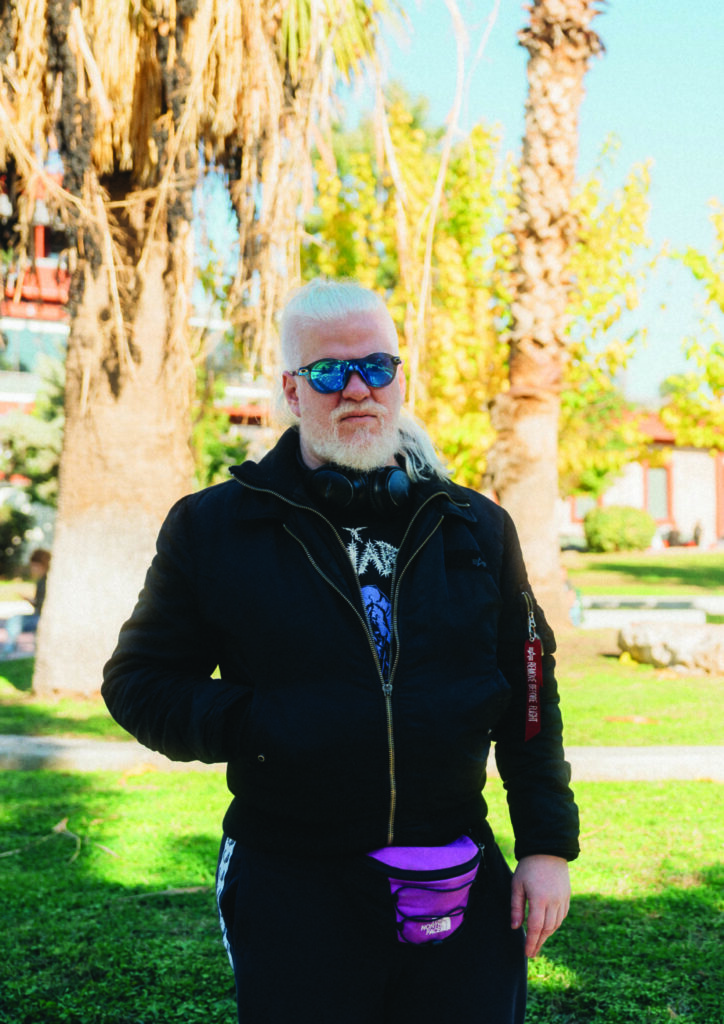
Lykourgos is a visual artist and disability/queer activist from Athens, Greece (b. 1988, Athens). He currently lives and works between Oslo and Athens. He holds a BA from the Athens School of Fine Arts and an MFA from Kunstakademiet at KHiO. His work has been exhibited at the 6th Athens Biennale, Akershus Kunstsenter in Lillestrøm, Norway, Arnolfini Gallery in Bristol, UK, the Freud Museum in London, Fylkingen in Stockholm, Sweden, and the Norwegian National Gallery.
His artistic practice engages with the production of new mythologies and legends that replace conservative narratives that have become obsolete. His work reinterprets mainstream stories, often centered on heroic victory, transforming them into alternative fictions that foreground failure and give space to those positioned as “losers.”
In his recent work, he moves away from the sighted paradigm of “seeing” art, developing instead a more inclusive approach to worldbuilding that invites blind and low-vision audiences without excluding others. His soundscapes construct environments and spatial experiences, while text operates as a means of visualizing sound. His theoretical framework draws from queer and disability studies, engaging with thinkers such as Jack Halberstam, Margrit Shildrick, Rod Michalko, and Rosemarie Garland-Thomson.

Co-funded by the European Union. Views and opinions expressed are, however, those of the author(s) only and do not necessarily reflect those of the European Union or the European Education and Culture Executive Agency (EACEA). Neither the European Union nor EACEA can be held responsible for them.
The programme is implemented with the financial support and under the auspices of the Hellenic Ministry of Culture.