
In a Crip Time and Space
A walking and movement workshop for people with and without disabilities by Demy Papathanasiou

What would happen if we allowed our bodies to move in their own time? What if walking was not simply a means of getting somewhere, but a way of being present?
Demy Papathanasiou invites us to the workshop In Crip Time and Space, on Sundays February 8 and 15, 13:00-16:00, at the Choros of liminal. Across two sessions, we will explore walking, pausing, and moving through the city, creating space for difference, care, and slow movement.
The workshop is open to people with and without disabilities, and no prior experience in dance or movement is required.
This activity is part of the European project SEED – Social and Ecological Engagement through Dance.
What to expect
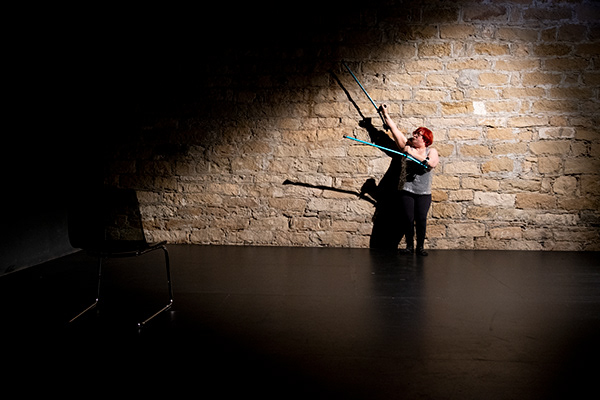
In Crip Time and Space is a series of accessible workshops where we experiment with different ways of moving and getting around. The practice is grounded in care, attentiveness, and respect for the diverse needs and rhythms of each body.
Instead of treating walking as a way to get somewhere quickly, we will use it as a way of noticing: our bodies, the city, and each other.
The workshop is based on the concept of Crip Time—the idea that bodies experience time and movement in many different ways—and is connected to ecological practices that emphasize attentiveness and care for oneself as well as for others.
Who is it for?
The workshop is open to:
- People with and without disabilities
- People with chronic pain or fatigue
- People who are curious about movement, walking, or care
- Artists and non-artists
You don’t need any dance or movement experience.
Accessibility & Care
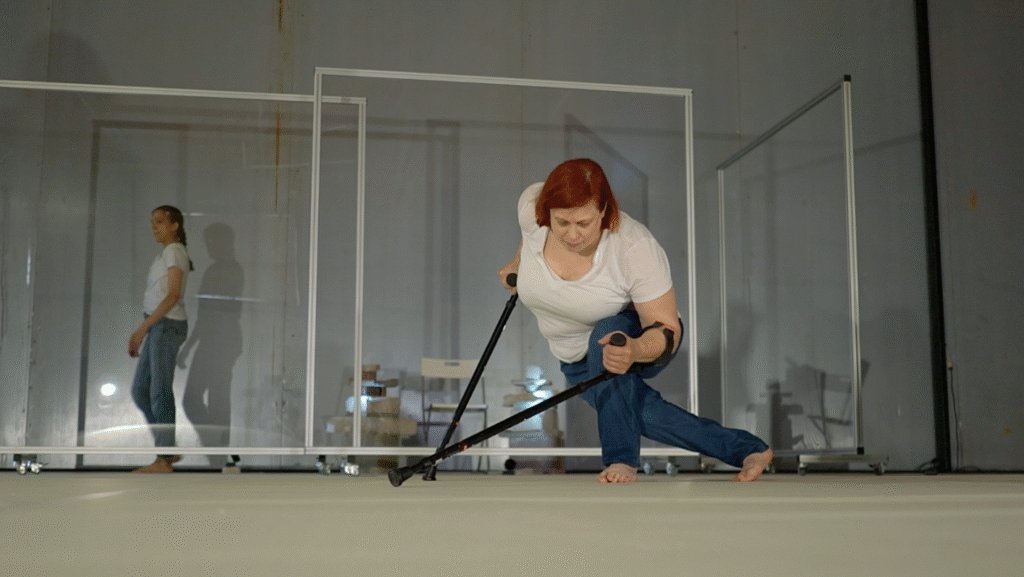
Accessibility is an integral part of the workshop. Throughout the two sessions, each participant can choose how much and in what way to move, taking breaks whenever needed to rest or observe. Mobility aids are welcome and form part of the practice. Care is a shared responsibility, and there will be ongoing communication and adaptation to meet the needs of the group.
👉 Simultaneous interpretation in Greek Sign Language will be provided.
📌 Sign Up
You can express your interest in participating through the form below:
For more information, contact us by email at info@liminal.eu
Useful information
Days: Sundays February 8 and 15 2026
Time: 13:00-16:00
Location: Choros (Plateia Theatrou 6-8, Athens)
Cost: Free
Registration: By completing this form
“Choros” is wheelchair accessible and has an ADA-compliant restroom.
Demy Papathanasiou

Demy Papathanasiou is a Crip dancer and choreographer based in Athens.
Since 2013, she has been actively involved in programs of the Onassis Foundation and has served as artistic co-director of Theatre enCorps Collectif. Her artistic trajectory has been shaped through participation in national and international workshops and collaborations with organizations such as the Holland Dance Festival, Skånes Dansteater, and Stopgap Dance Company. In 2018, she completed a Minor Concentration in Contemporary Dance Practices with a focus on choreography, becoming the first disabled dancer in Greece to earn a degree in dance.
Since 2018, she has consistently presented choreographic works including Dançor, Journey, [New] Horizons, and You Walk, performed at festivals in Greece and abroad. Her experimental short film You Walk received an Honorable Mention Jury Award at the Festival VideoAndanza Internacional (2023).
In 2019, she curated the closing ceremony of the international collaborative project Seven to the Seventh at Nostos Festival, bringing together different dance groups to collaborate. She also co-led, with Maria Koliopoulou, the workshop Making the Leap: Dancer to Choreographer as part of the Europe Beyond Access Lab and served as co-coordinator, with Maria Vlachou, for the closing symposium of the first Europe Beyond Access: Disability and Transforming the Cultural Ecosystem in Brussels.
Since 2019, she has been in ongoing collaboration with the Prosxima Dance Company as a dancer and choreographer, participating in workshops and receiving artistic support from the company.
In 2024, she presented her first solo performance Who am I today? at the Beyond DisDance Festival in Cyprus. Since then, the work has been touring as part of the Dance Diptych of the Prosxima Dance Company, led by Maria Koliopoulou. In 2025, she received a grant from Culture Moves Europe to continue her research through collaborative residencies.

The SEED project is funded by the Erasmus+ programme (KA210-ADU – Small-scale partnerships in adult education)